
Maine's Leading Independent News Source
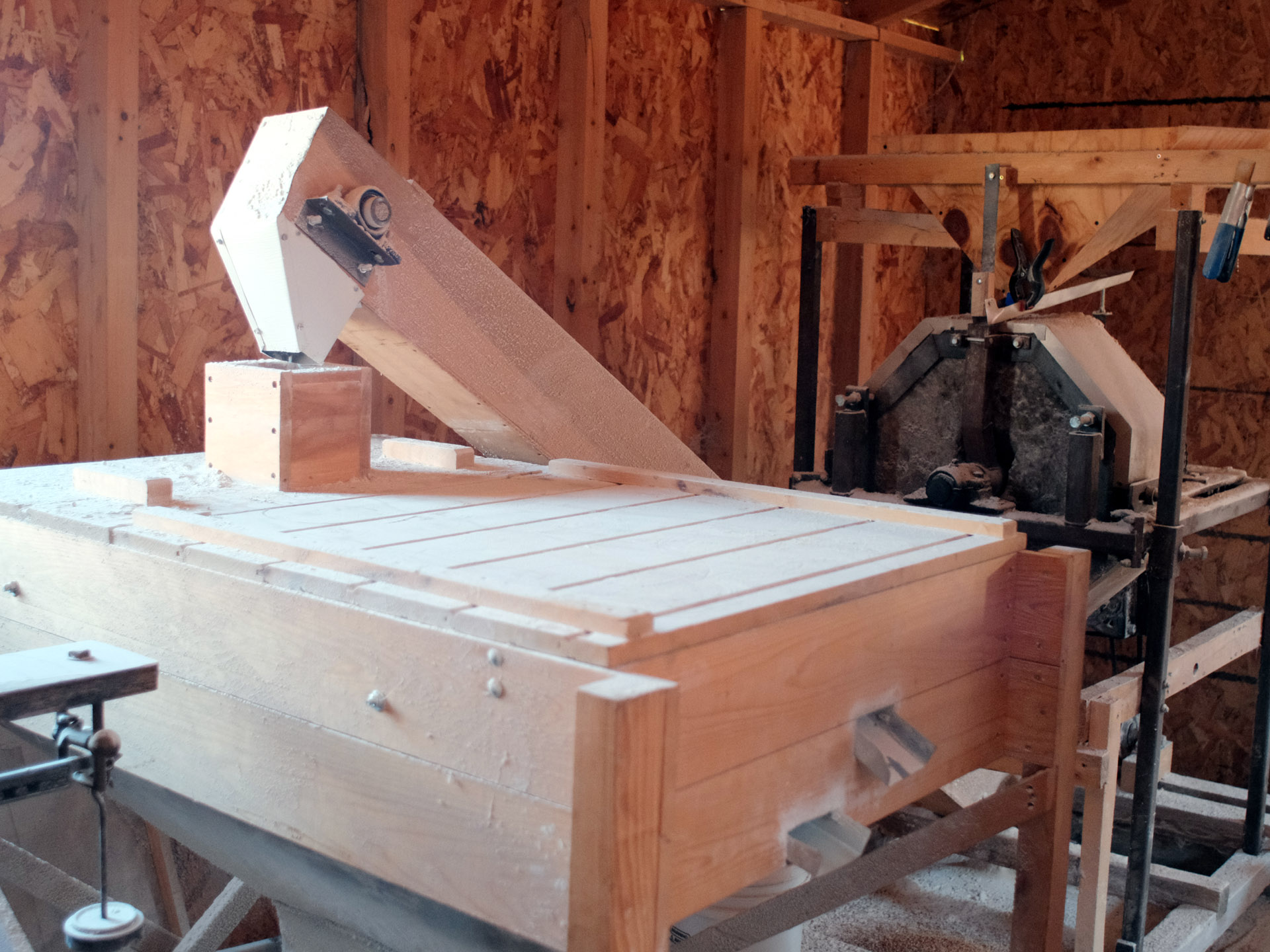
A small, artisan stone grain mill has been in operation at J&J Mini Barns on the Houlton Road in Easton for several years. The mill can produce 60 pounds of whole grain flour per hour.
photo/David Deschesne
By: David Deschesne
Fort Fairfield Journal, June 10, 2026, page 1
Ten years ago, Jonas Swartzentruber, from J&J Mini Barns on the Houlton Road in Easton, purchased a used stone mill for milling flour from wheat. Over the years he has refurbished it, added a sifter and has been milling fresh, locally grown organic wheat for the Amish community and the local community at large over the past few years. He also is providing heirloom Einkorn wheat, grown on a farm in Pennsylvania. The Einkorn wheat variety goes back over 4,000 years and has not been genetically modified by corporate wheat producers due to its smaller yields. However, Einkorn has perhaps the best nutritional value of all wheat varieties.
The organic wheat Jonas mills into whole grain flour is sourced from a farm in Mars Hill. He gets spelt from a family farm in Easton. While the Einkorn wheat is sourced from Pennsylvania, a family in Easton is growing some locally in order to acclimate it to the area and provide a local source in the near future. He expects the Easton crop of Einkorn wheat to be fully acclimated and up to speed by the 2027 growing season.
“The Einkorn has to be acclimated for several years before the yields get up to a usable level,” said Jonas. “That means the wheat berries from that local crop are harvested then planted the following year for a few years to get it used to the soil and the weather. The soil is very important and it needs a robust microbiome for Einkorn to adequately grow. Einkorn does not do well in factory farmland which has been awash in chemical fertilizers and commercial weed killers. None of the wheat we mill here has any chemicals used on it so it does not cause all of the problems commercially produced wheat does.”
He says the soil in Aroostook County is severely depleted of essential minerals and a microbiome due to years of factory farming and chemical fertilizer treatments that caused people to deviate from the practices of manure and composting that our parents used to use for their family gardens up until around the 1970's when commercial chemical fertilizers began to be marketed to consumers for their ease of use.

Composting is the main source of fertilizer for the farms that grow organic wheat. This draws in all the worms, insects and microbes, as well as fungi, that break down the composted material and enrich the soil for the wheat plants to adequately grow. This lack of chemical treatments is very beneficial not only for the plants but for the humans who consume them as well. “Many people have problems eating wheat these days and the doctors misdiagnose them as ‘gluten intolerant,’” said Jonas. “The reality is in most cases it's the glyphosate weed killers sprayed on the wheat on industrial wheat farms that is causing the problems and the gluten actually has nothing to do with the illness.”
Glyphosates are the primary ingredient in the popular weed killer designed by Monsanto sold under the trade name “Round Up.” Earlier this year the state of Florida identified half a dozen commercially available breads as having elevated levels of the weed killer in them. President Trump campaigned on removing these toxic chemicals from the food supply but as soon as Florida announced the tainted breads, Trump issued an executive order endorsing the use of glyphosates in the food supply and providing a de facto legal immunity from damages caused by the companies that either produce or use it in the food production process.
On industrial wheat farms, the glyphoste weed killer is sprayed on the wheat to kill it prior to harvest in the same way farmers use top killer to kill the potato tops in potato fields prior to their harvest. Unlike potato tops, which are not part of the food production chain, the weed killer sprayed on wheat makes it all the way to the factory flour mill where it is added in to the finished flour because there is no real way to remove or clean it from the wheat. Most commercial wheat products like pastas, breads, cookies, pastries, breakfast cereals, etc. have a certain level of this weed killer in them but that is not talked about in pleasant conversation in politics as the population continues to get sicker and sicker, and thus need more and more expensive health care and prescription drugs to treat the sides effects of ingesting trace amounts of this toxic weed killer which bioaccumulates in the bodies of the consumers over time and adversely affects their own gut microbiome, which is essential for proper food digestion.
The organic wheat Jonas mills in Easton has no weed killers on it and is raised with no chemical fertilizers; thus, it is non-toxic compared to the factory wheat-based products being sold in nearly every grocery store in the country these days.

The stone ground method Jonas uses retains all the vitamins and minerals in the wheat as well as the essential fats and oils. Because of this lack of factory refining, the wheat only has a shelf life of three days after it's been milled, before baking. Industrial roller milled wheat, which has been stripped of all its original vitamins, minerals, fats and oils can last for months, or up to a year, on the shelf. Factory wheat also has chemicals added in for bleaching and bromating and synthetic vitamins are added to just barely meet the threshold for US FDA requirements. But factory wheat is essentially dead material at that point and nearly worthless as a food source, from a nutrition standpoint. After baking, the finished product of stone ground organic wheat, such as breads, cookies and cakes, has a shelf life of two weeks, which can be extended if the product is refrigerated or frozen.
Of all the organic wheat varieties available, Einkorn wheat has the highest vitamin to starch ratio. Einkorn wheat also has a much lower glycemic index than factory-produced flour and bread so it does not cause sugar spikes like refined flour does.
The milled Einkorn wheat flour is available at his location at J&J Mini Barns on Route 1a (the Houlton Road) in Easton, just a little south of the Easton/Fort Fairfield town line. The milled flour is also available with or without the bran for $15 for a 5 pound bag and $28.00 for a 10 pound bag. Removing the bran creates a lighter flour that allows for lighter, fluffier breads but Jonas recommends keeping the bran in the mix for its additional vitamins and fiber content. “It's a bit of a culture shock for people transitioning from store-bought bread to the Einkorn stone ground wheat because the factory bread is so refined that it is much softer and fluffier than these traditional breads which don't rise as high and are more dense,” said Jonas. “But after eating the stone-ground organic wheat bread for a year or so, it would be as much of a shock to go back to the factory bread.”
Due to the short self life of the stone ground flour, the milling is usually done while the customer waits. “Our mill can process 60 pounds of flour per hour,” said Jonas. “I usually have one fresh five pound bag ready each day for customers but I can mill more very quickly if several people show up wanting some.”
Since the stone-ground Einkorn flour can be tricky to bake with, Jonas also offers an Amish cookbook with recipes and baking suggestions for this type of flour. This book is available from Jonas for $15.00.
He also provides the de-hulled wheat berries ready for milling for people who have small countertop mills at their homes. But he said those mills don't produce a flour as fine as what he can produce with his stone ground mill.
In addition to providing a milled product Jonas also sells the Einkorn wheat berries which can be planted by people who want to try to establish a crop for themselves. But he stresses that no commercial chemical fertilizer should be used, only traditional composting methods and undergoing an acclimation period of three to four years before the plants begin to produce their maximum yields. “These are ancient grains, not industrial food,” Jonas explained. “It takes some time to establish these grains locally. We all have to slow down life to get the most out of it and our food.”
The hulled Einkorn wheat berries, ready for planting, are available from Jonas for $150 per 50 pound bag.
Jonas is also working toward getting a wheat puffer online to produce puffed wheat cereal with his organic wheat. With the addition of the organic honey he currently harvests from his own bee hives, this will surely be a tasty cereal treat when that product line gets fully developed.
Jonas Swartzentruber is a wealth of knowledge when it comes to the nutritional value of foods, wheat in particular, and anyone interested in learning more about the milling process is encouraged to stop in and chat with him. Since he is Amish, there is of course no way to call, email or text him. But, in-person conversations and interactions are always the best in today's fractured world of digital communications and social media firewalls. Food, like relationships, is best when it is touched less by digital technology and algorithms and more by the soul of personal interactions.

WFFJ-TV
Fort Fairfield Journal Television produces news and documentary videos. View them on our censorship-free Rumble channel.
Link to WFFJ-TV's Rumble Channel >>
© 2026 David R. Deschesne
Fort Fairfield Journal
P.O. Box 247
Fort Fairfield, Maine 04742
(207) 472-3900
editor@fortfairfieldjournal.com